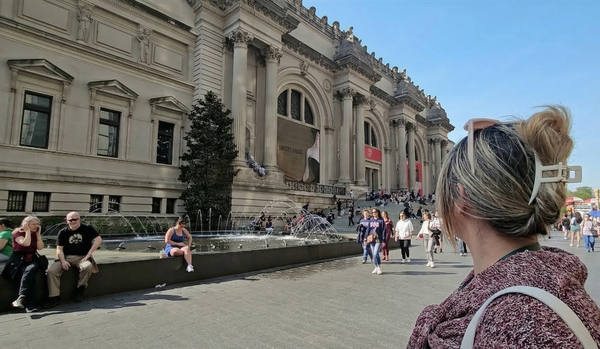
10.29 | reflecting on getting a new masters in my 40s
In August, I wrapped up a year-long master's degree in Climate and Society at Columbia University. At 41, walking into a cohort where the median age hovered around 24 felt like the premise of a mid-tier comedy


✉️ letter #80
Hi friends! It's been a while! In August, I wrapped up a year-long master's degree in Climate and Society at Columbia University. At 41, walking into a cohort where the median age hovered around 24 felt like the premise of a mid-tier comedy. In fact, I guess it was.
🎼 the soundtrack | sleeping in my car - yeek
I’ve spent the last few weeks trying to consolidate the experience into something legible, and I've unpacked it in detail in a Youtube video:
Gasp. A new newsletter after 6 months and a new Youtube video after ...14? You're very welcome.
While the video walks through the generational whiplash of returning to the classroom after fifteen years in the working world, the thread I can’t stop pulling on and that I continue to mull over is how AI has really screwed with the classroom dynamic.
This summer, MIT published a remarkably candid 40-page report from its Ad Hoc Committee on AI Use in Education, and reading through those findings felt like a dispatch from the front lines of every group project I survived this year.
The report warned against what researchers termed "cognitive surrender"—the habit of outsourcing the very first hint of intellectual struggle to an LLM. When you're facing a demanding unit load and a fast-approaching deadline, reaching for a tool that spits out a syntactically immaculate summary is an obvious efficiency move. The problem is that higher education was not designed to be efficient. In fact, its inefficiency is part of the point.
Learning requires some struggle. It requires sitting with an ambiguous problem, challenging yourself to understand an obtuse data table, stumbling through various methods of doing things until you arrive at a conclusion that you can defend... even if, in the end, it's proven wrong by someone else. Helping to spark that learning has been the ideal for higher education, at least in the last few hundred years.
And while I'm sure that a majority of the students I matriculated with had those goals in mind, several convening factors our turning our best efforts against us. We were already in a broken dynamic – the American academic system has long treated degrees, especially Ivy League ones, as a luxury commodity. That's led to surprisingly less-than-selective moneymaking masters degrees targeted at a very young and under-employed cohort, and the requisite grade inflation to make that six-figure investment seem worthwhile.
Then the magical slot machine of automated text was dropped in our laps. Seminar rooms were quiet because everyone had, if they'd done anything at all, Chat-GPT summarized the readings so there wasn't much to convincingly ask or argue about. Online discussion boards were filled with synthetic prose. Every presentation sounded like a Claude ad lib. Somehow, too many kids thought that dropping in hallucinatory citations last minute into a shared group project doc was an okay thing to do.
Even as I was endlessly annoyed by it (the editor in me could NEVER), I get why people who haven't built up the muscles to see through trash would think the polished turds they were flinging at us all were acceptable. I'm sure it all looks pretty good when you haven't seen enough actual writing to know better - in fact, one study showed that it wasn't generational divide so much as familiarity with the AI writing process that predicted if a person could tell if something was "written with AI."
Anyway, the MIT report gave recommendations on what could stem the tide of "cognitive surrender" in the next generation of students. I go into if I think they'll be adopted in the video.
Regardless, this is something all of humanity will need to find a solution to, and fast. It's funny -when Pixar's Wall-E came out, we all figured the brainrot would come from endless entertainment and lack of movement. Now we've got that and the even more insidious laziness of not having to think any thoughts at all.
🪢related threads
- NPR has a deep dive on the ground-level reality of AI in the grade school classroom, tracking how educators are trying to rescue reading comprehension and basic writing stamina from the path of least resistance.
- Which tracks with why New York City has released the "most expansive student-facing AI policy in the country" – namely, this next year, nobody 8th grade and under is allowed to use it, and high schoolers need to go through AI literacy classes.
- Which is incredibly important because growing up with AI doesn't mean you're immune to it. One study has found that GenZ might be much more confident about their ability to detect AI than their actual results showcase.
- I recently caught Dr. Lauren Mushro's incisive (and somewhat terrifying) autopsy of how LLMs are flattening human expression at a civic art lab gathering; give her a follow for language and machine learning thoughts.
- Perfect Union and the AI Now Institute held an event this month in New York that turned out to be a huge deal. There was a line to go in, even if you'd registered, and it was standing room only. I loved just about every panel (it's actually how I found out about the AI moratorium in NYC), but I especially enjoyed that they ended the event with an appeal to human imagination. You can watch the full hour featuring Naomi Klein and Arundhati Roy and moderated by Empire of AI author Karen Hao right here:
✨enjoying: a piece of pop culture fun
One of the best sci-fi series I’ve watched in years is Pantheon, adapted from Ken Liu’s interconnected "Singularity" short stories in The Hidden Girl and Other Stories. The plot starts with a teenager receiving messages from an unknown number that claims to be her late father, quickly unraveling a massive corporate conspiracy around uploaded intelligence ("UIs"). Think of it as a kind of techno-thriller.
But what makes it extraordinary is that the series doesn’t stop at just dissecting digital exploitation (at risk of spoiling the second episode, tech titans are turning human consciousness into cloud-hosted labor). It asks a deeper question: can the human genius that companies crave enough to exploit us ever be untangled from our messy emotional needs and desire for human connection?
🗨️a final quote
There are painters who transform the sun to a yellow spot, but there are others who with the help of their art and their intelligence, transform a yellow spot into sun”
― Pablo Picasso
Stalk me on Social Media
Instagram | TikTok | LinkedIN | Twitter | Goodreads | Spotify