Failure to Adapt? Climate Mobility and History in Haiti
Haiti’s struggle is is the continuation of a centuries-long fight for true sovereignty, not just an environmental crisis.

The following is a loose transcription of a case study I wrote up for my Climate Adaptation class at Columbia Climate School as part of a mock Conference of Parties (COP) panel on the topic of "Climate Mobility: Adaptation or Failure to Adapt." My case study was presented alongside similar issues on human migrations around the world. As of now, I will only be showcasing my case, my words, and my slides.
Note that the "royal we" is used a lot as we were tasked with actually representing the countries of our case studies. Did it feel weird to pretend to represent a country I've never actually been to? Yes, quite. But I'm grateful for the opportunity to learn more about it anyway.
Like my colleagues, I’m going to start by discussing how Haiti is extremely vulnerable to climate change. We have seen rising sea levels, droughts, hurricanes, and marine heatwaves hit us in the last two decades more and more frequently. Because we rely on farming for subsistence, there is often not enough food to go around. Because there are also not enough good jobs, 37% of our entire population currently lives in extreme poverty, which makes 96% of our population vulnerable to these climate shocks.
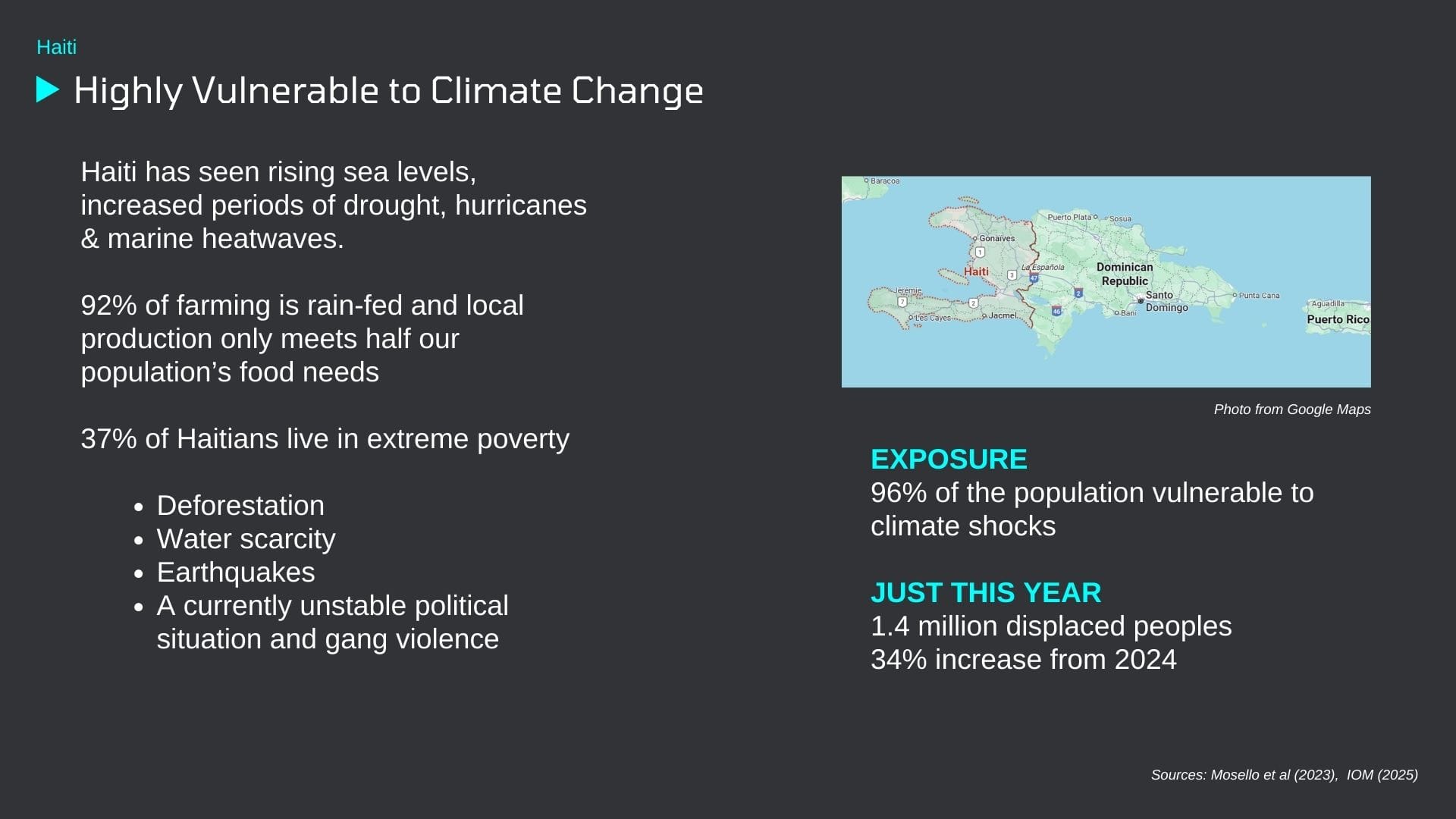
Alongside that, we are also dealing with deforestation, water scarcity, earthquakes, and a currently incredibly unstable political situation, which has led to quite a lot of gang violence. These are non-climate problems, but they are gigantic problems. That means that just this year, 1.4 million of our people were displaced—a 34% increase from last year.
I must emphasize that this frustrating situation did not appear out of nowhere. When colonizers first came to this land, they exterminated the indigenous islanders and their knowledge, and razed our natural ecosystem to the ground in order to plant sugarcane and other money crops. This contributes directly to our current environmental vulnerability.
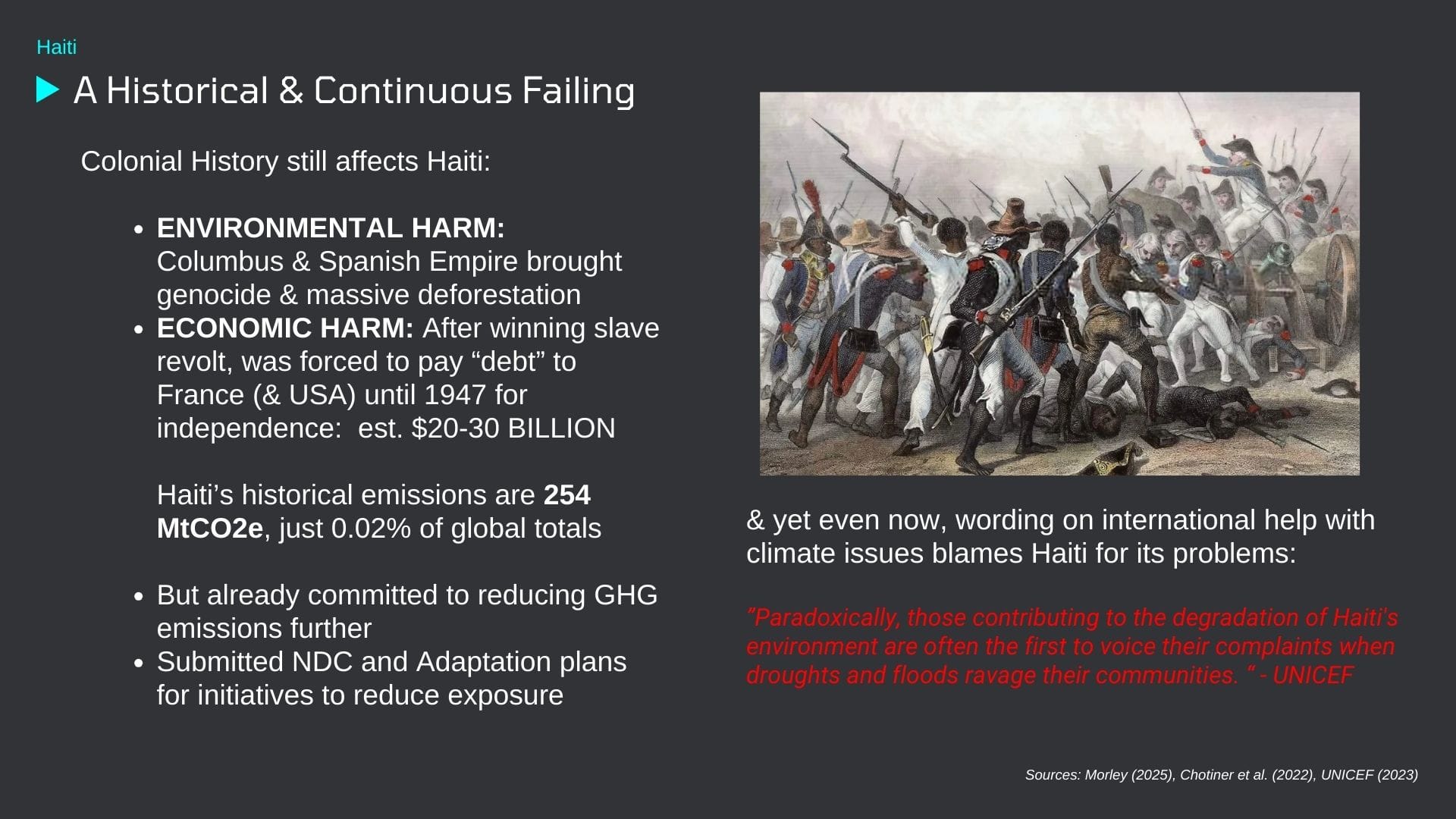
Quite insultingly, when our ancestors won a slave revolt against France, we were sued for damages and forced to pay a monetary debt for our independence to both France and, later, to the United States as they took over France’s debt. This contributes directly to why we are poor. We ended up paying between $20 to $30 billion by 1947 estimates, which is even more now.
Despite all of that, we have been active participants in the global climate change conversation. We only contribute 0.02% of global CO2 totals, but we are committed to reducing our greenhouse gas emissions even further. We have submitted NDC (Nationally Determined Contributions) and adaptation plans for initiatives to reduce that exposure.
I want to point out that we do not see this effort, despite our hardship, reflected in the Global North's attitude towards us. I found a note from UNICEF where they, when talking about our climate migration issues, said that "paradoxically, those contributing to the degradation of Haiti’s environment are often the first to voice their complaints when droughts and floods ravage their communities." This kind of condescending voice is quite inappropriate and also not very helpful.
I believe that what we actually need here in Haiti is funding and an attitude that addresses the historical wrongs and the actual problems that we deal with regarding climate change.
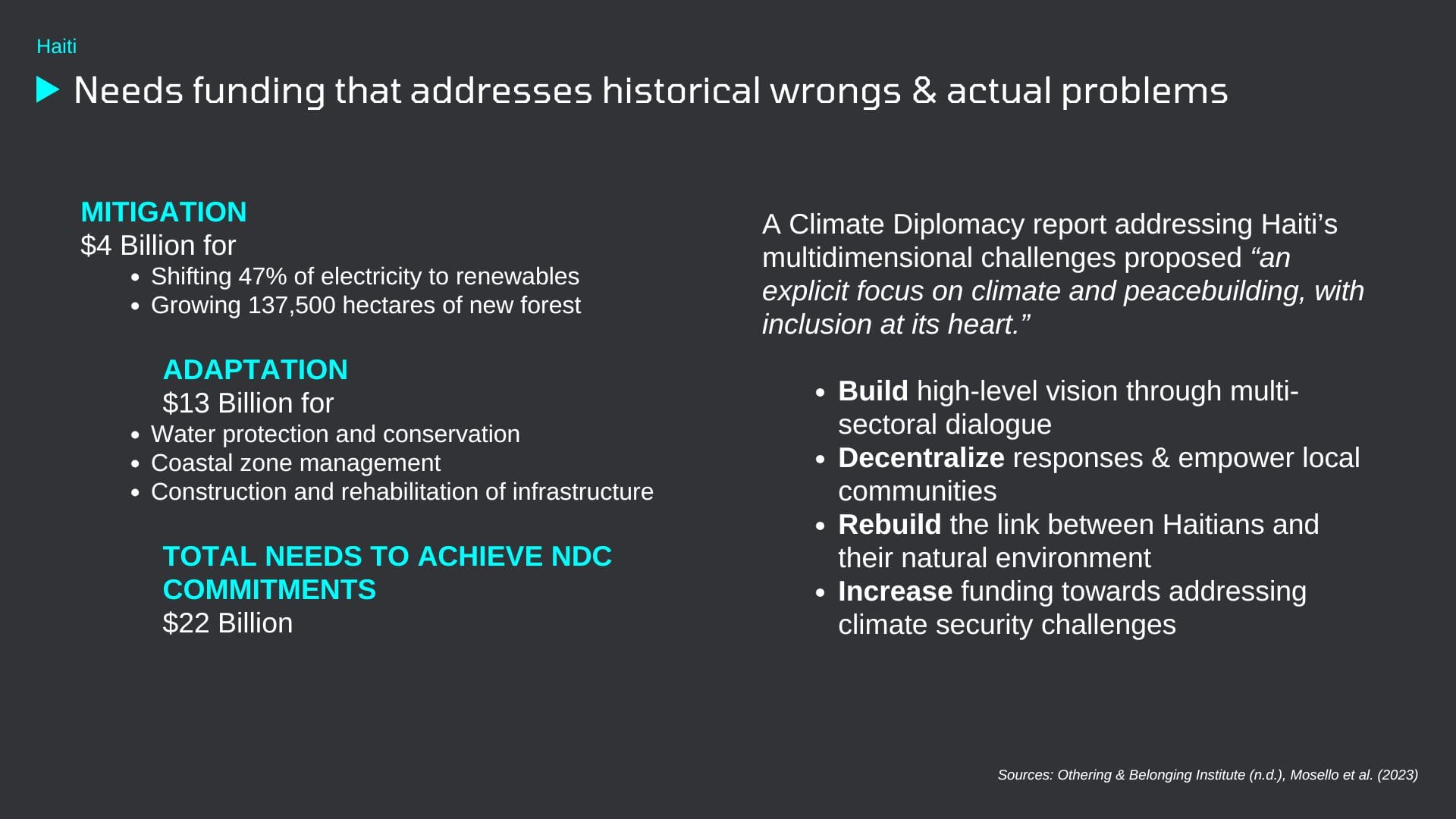
For mitigation, we have already found that we need $4 billion to shift 47% of our electricity to renewables. We have also committed to growing more hectares of new forest for adaptation, which is a much bigger problem for us.
We need $13 billion for things like water protection and conservation, coastal zone management, and the construction and rehabilitation of our infrastructure from both earthquakes and these constant hurricanes. In total, our needs to achieve our NDC commitments are tallied at around $22 billion—which, you might notice, is very similar to the amount of debt that we had to pay for our freedom.
We found a recent climate diplomacy report provided a good indication of an excellent path forward. It stated that we need to:
- Build high-level vision through multi-sectoral dialogue.
- Decentralize responses and empower local communities.
- Rebuild the link between Haitians and their natural environment.
- Increase funding towards addressing these climate security challenges.
I wanted to present a case that actually does so and has been doing so for the last 30 years. FoProBiM (Fondation pour la Protection de la Biodiversité Marine) is Haiti's only local dedicated coastal and marine environmental NGO. It was started by Haitian Jean Wiener.
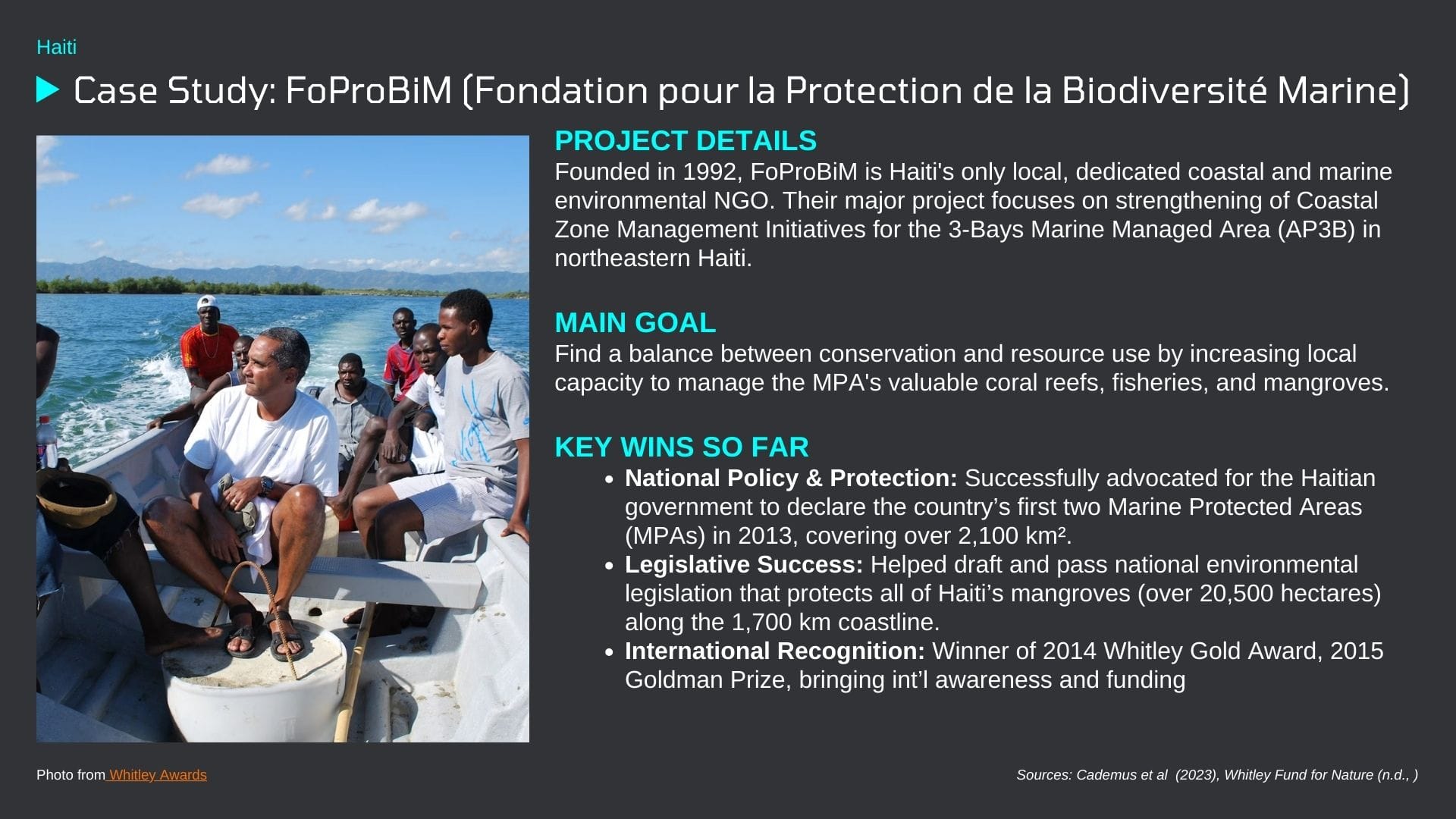
Their major project focuses on strengthening the coastal zone in northeastern Haiti in the Three Bays Marine Managed Area. Its main goal has been to find a balance between conservation, resource use, and empowering locals for both employment and learning opportunities. There have been several key wins:
- Marine Protected Areas: FoProBiM successfully advocated for the government to create its first marine protected areas, now covering about 2,100 square kilometers.
- Legislation: It helped draft and pass national legislation to protect Haiti’s mangroves.
- International Recognition: It has brought Haiti into the world’s view and secured funding for the program to continue.
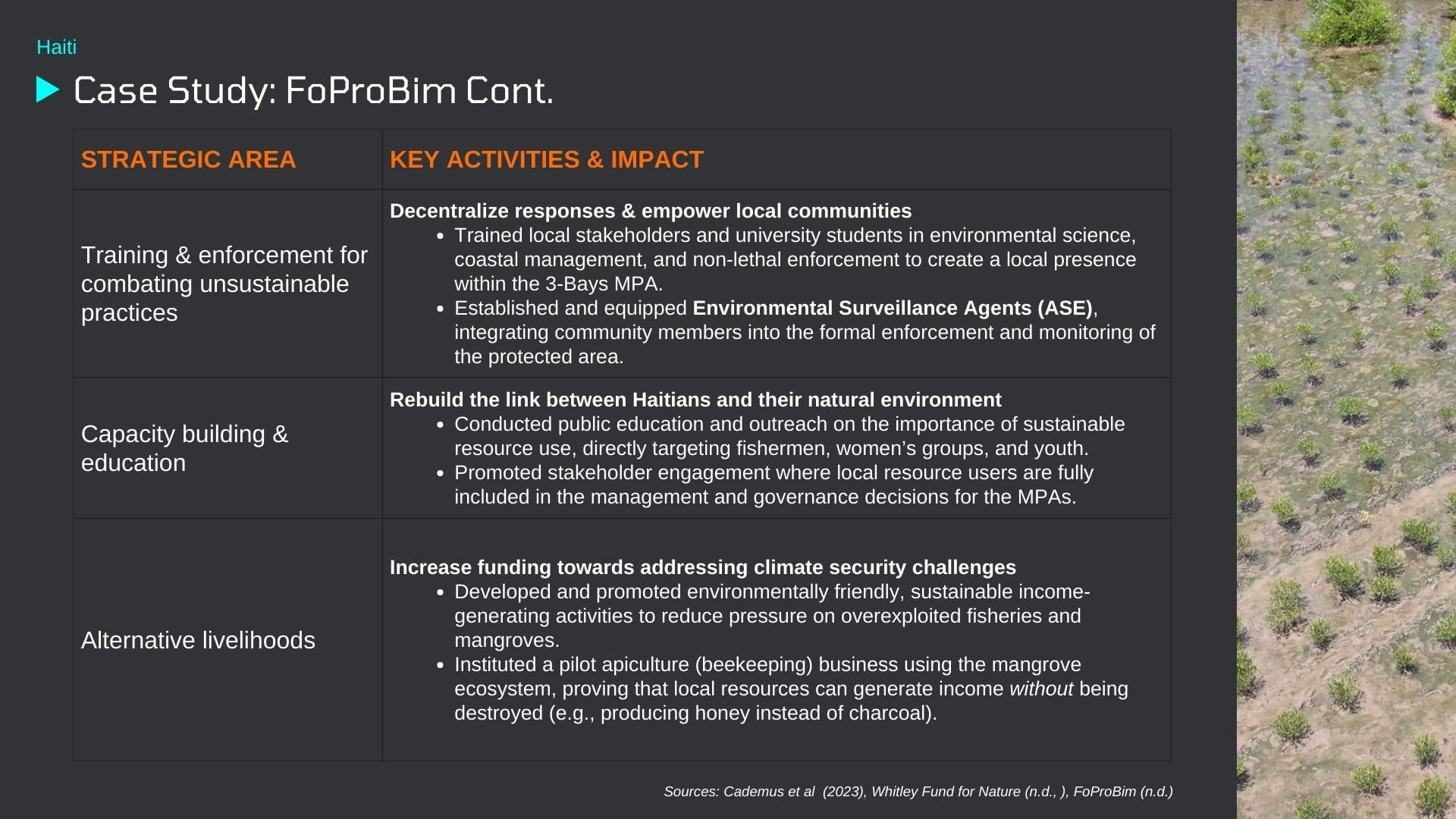
This project decentralizes responses by training local stakeholders in environmental science and non-lethal enforcement. It rebuilds the link to the environment through educational outreach and stakeholder engagement. Finally, it addresses climate security by finding sustainable, income-generating activities.
For instance, we now have a beekeeping business that allows locals to use the mangroves in an economically feasible way that does not involve slashing and burning them.
In closing, Haiti’s struggle is is the continuation of a centuries-long fight for true sovereignty, not just an environmental crisis. The $20 billion we need to meet our climate commitments is a striking echo of the debt we were forced to pay for our independence—a debt that hampered our development for generations.
However, as organizations like FoProBiM demonstrate, the expertise and the will to transform our future already exist within our borders.
Now, one of the primary issues we face with external funding for climate adaptation and migration is that Haiti rarely gets to decide how that funding is allocated. Much of the capital we receive is tied directly to specific projects, which tend to be mitigation-focused—specifically regarding the "greening" of our infrastructure.
However, as you may have noticed from our NDC tally, our most urgent need is for adaptation. While the project I highlighted involves the Haitian national government and utilizes a "bottom-up to top-down" approach, we must consider who truly sits at the "top." For Haiti, it often feels as though the top is not our own government, but rather the international intergovernmental bodies that control how we receive and use funds.
We are not asking for charity when we ask for more funding and more control; we are calling for climate justice and the strategic investment required to correct historical wrongs. By empowering local communities and securing the necessary funding, we can move from a state of vulnerability to a model of resilient, sustainable growth. Let us ensure that the next chapter of Haiti’s history is defined by its restoration, not its exploitation. Thank you.
Presented: October 29, 2025
Bibliography
International Organization for Migration. (2025, October 15). Displacement in Haiti reaches record high as 1.4 million people flee violence. https://www.iom.int/news/displacement-haiti-reaches-record-high-14-million-people-flee-violence
Mosello, B., Destrijcker, L., McMurray, S. A., & Schmelzer, N. (2023, October). Roots for peace: Uncovering climate security challenges in Haiti and what to do about them. Climate-Diplomacy
Morley, S. P. (2025, May 2). Understanding climate migration through a racial justice lens: Haiti as a quintessential example. OpenGlobalRights. https://www.openglobalrights.org/understanding-climate-migration-through-a-racial-justice-lens-haiti-as-a-quintessential-example/
Chotiner, I., Kestenbaum, D., & Kufour, L. (Hosts). (2022, June 22). The greatest heist in history: How Haiti was forced to pay reparations for freedom (No. 1152) [Audio podcast episode]. In Planet Money. NPR.
United Nations Children's Fund (UNICEF). (2023, October 10). Haiti facing the challenge of climate change. https://www.unicef.org/haiti/en/stories/haiti-facing-challenge-climate-change
Othering & Belonging Institute. (n.d.). Haiti case study | Climate refugees. Retrieved October 25, 2025, from https://belonging.berkeley.edu/climatedisplacement/case-studies/haiti
Cademus, R., Fondation pour la Protection de la Biodiversité Marine (FoProBiM). (n.d.). Strengthening of coastal zone management initiatives for the 3-Bays Marine Managed Area, Haiti. PANORAMA. Retrieved October 25, 2025, from https://panorama.solutions/en/solution/strengthening-coastal-zone-management-initiatives-3-bays-marine-managed-area-haiti-0
Whitley Fund for Nature. (n.d.). Conserving Haiti’s coastlines. Retrieved October 25, 2025, from https://whitleyaward.org/winners/conserving-haitis-coastlines/
Fondation pour la Protection de la Biodiversité Marine (FoProBiM). (n.d.). Home. Retrieved October 25, 2025, from https://www.foprobim.org/