03.13 | do women have to be naked to get into the met?
If we’re still trying to shove ourselves through physical doors, and our machines are actively shutting digital ones, how do we break this loop?

✉️ letter #77
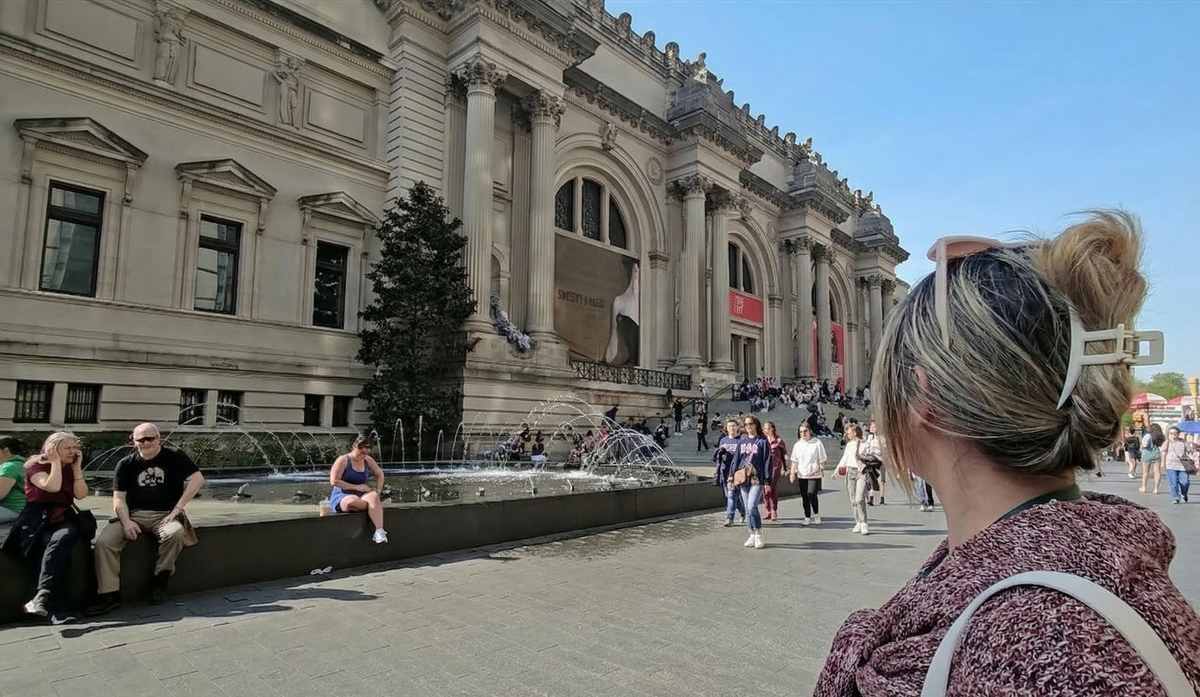
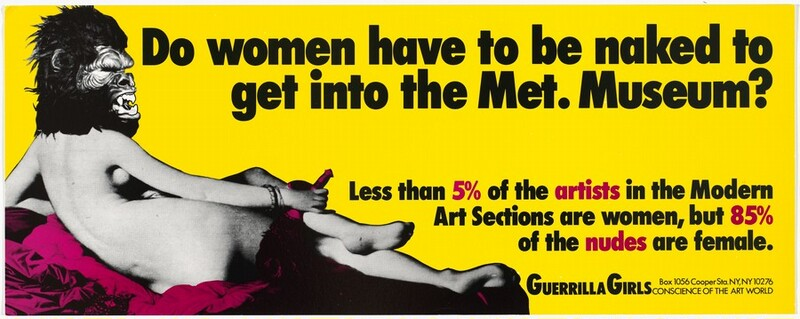
In 1989, women from the feminist art group Guerrilla Girls walked into the Metropolitan Museum of Art and stopped before La Grande Odalisque, painted by Jean-Auguste-Dominique Ingres. It was a “historically significant” feature of the institution, featuring a woman reclining, nude, her spine impossibly elongated, her body inviting the viewer’s gaze. She was also not uncommon.
The group did the math. While 85% of the nudes in the Met’s Contemporary and Modern wings were female, only 5% of the artists across those areas were actually by women. It prompted them to ask “Do women have to be naked to get into the Met?”
🎼 the soundtrack | i never said i was sane - jessie reyez
It’s a question that lives rent-free in my head, and especially more so as Women’s History Month prompts a thousand op-eds and listicles on women to know, where women are now, and — most depressingly — where they still aren’t.
Similarly to the Met in 1989, images and stories about us abound in the climate movement, perpetually reclining in the tragedy of the frame. You can skip a pebble and hit a dozen reports of the “disproportionate impact” climate change has on us — we’re most likely to get pushed into poverty, we’re most likely to die in an extreme weather event (to add insult to injury, gender-based violence rises 30% after climate disasters), we’re less likely to be included in research on the effects of climate change.
Yet we tend to be the face of it anyway. The imagery about the emotional register of the crisis is feminine: a grieving mother in a flooded urban street, an indigenous seed-saver, a determined young protestor with a hand-painted sign. Science says people empathize more when they see a girl.
We’re victims and we’re art objects, but what do we have to do to hold the brush?
- Only 33% of the core authors at the IPCC, the key body for scientific research underpinning global climate policy development, were women — already an increase from the very sad figure of 8% in 1990.
- Only 19 countries party to the Rio Conventions have gender parity across their environmental focal points, and 51 countries are represented only by men.
- The last COP 30 in Belém was the most gender-balanced so far, with 40% of delegates being women. But this is barely statistically significant if you look at the past 5 years, where it’s hovered around a mean of 37%.
And I can’t help but suspect our physical exclusion is being mirrored now in our digital architecture. We see it on Spotify, where algorithms steer listeners away from female voices. The last couple of months of 2025, women on LinkedIN experimented with a “bro-boost” — by toggling their gender to “male,” they saw the professional reach of their posts surge. AI is super-charging already gender-biased algorithms, reinforcing our perceptions of who’s an authority through search and image results… I don’t even want to get into what Grok is doing. Apparently you don't even have to get naked to be a naked woman on the internet.
If we’re still trying to shove ourselves through physical doors, and our machines are actively shutting digital ones, how do we break this loop?
We can take a page out of the Guerrilla Girls themselves, who realized that if the institution won’t let you in, you change the terms of engagement. In a sense, all the LinkedIn “bro-boost women” were like this: turning LinkedIn’s own gender-based algorithms into the evidence of a systemic glitch. It helps to be kind of humorous about it.
And much like it wasn’t that there weren’t women artists in 1989, it’s not like there aren’t women at the front-lines, doing targeted climate work. According to former Canadian environmental minister Catherine McKenna, women are two and a half times more likely to demand government action on climate, more likely to advocate publicly and more likely to engage civically.
Women will keep seeking that seat at the table. They’ll keep up the accounting and the protests and the finding of new solutions. It’s on the rest of us, men and women, to remember them, realize their absence, and amplify that work... hopefully even when it’s not Women’s History Month.
🪢related threads
- For a couple of years, former-Irish president Mary Robinson and comedian Maeve Higgins got together to highlight women leading climate change solutions. Though the series is technically over, the episodes are still up, listenable to, and relevant. [Mothers of Invention]
- I also have to give a shout out to Katy Hessel's work on women artists, without which I would have not learned about the Guerilla Girls. Beyond the excellent (and deliciously sardonic) work she does highlighting women artists, she also has a Museums without Men podcast and a wonderful book, "The Story of Art Without Men." [Great Women Artists]
- This whole piece, but especially this right here: "When it all gets too much, I think about stuff like this: When someone plants a packet of those seeds in the coming weeks, the flowers will bloom and sustain the pollinators over the growing season. Or, they might eat the vegetables they grow and buy less stuff from the grocery store as a result. Then, if that person chooses to save the seeds from the spent plants at the end of the season, they’ll be able to grow another year of plants without spending any money at all, or trade them with a neighbor to grow something else. That right there is the opposite of extraction. It’s regeneration. It sounds poetic and kind of cliche, but it’s also entirely literal. We cannot lose sight of the fact that this is the way things are designed to work.
This is the work of our moment, I believe. Not saving seeds, but to find ways to circumvent this logic [of extraction] even while we still have to exist under it." [Rosie Spinks] - This year, the National Women's History Alliance is specifically highlighting women shaping a sustainable future. You can check out a primer on who you ought to know, and more, there. [NWHA]
✨enjoy these culture notes
I feel a little sorry that when this musical, featuring Idina Menzel, came out in New York last year, I kind of laughed at it. To be fair, I'd only seen a song in preview, and from what it looked like, it was all about Idina Menzel up in a tree. I probably joked about how many songs you could get out of the premise.
It wasn't until browsing the National Women History Alliance magazine that I realized its subject matter was a little more meaty than a hippy who lived on top of a sequoia (though it is also kind of that). Julia Butterfly Hill stayed for nearly two years on a wooden platform 180 feet above the ground to save the tree from logging by the Pacific Lumber Company – it became one of the most effective acts of nonviolent environmental resistance for conservation in modern history. There's a lovely interview between her and Idina that's a nice note to end on:
🗨️a final quote
Well-behaved women seldom make history
-- Laurel Thatcher Ulrich
Stalk me on Social Media
Instagram | TikTok | LinkedIN | Twitter | Goodreads | Spotify