03.06 | the riderless red horse
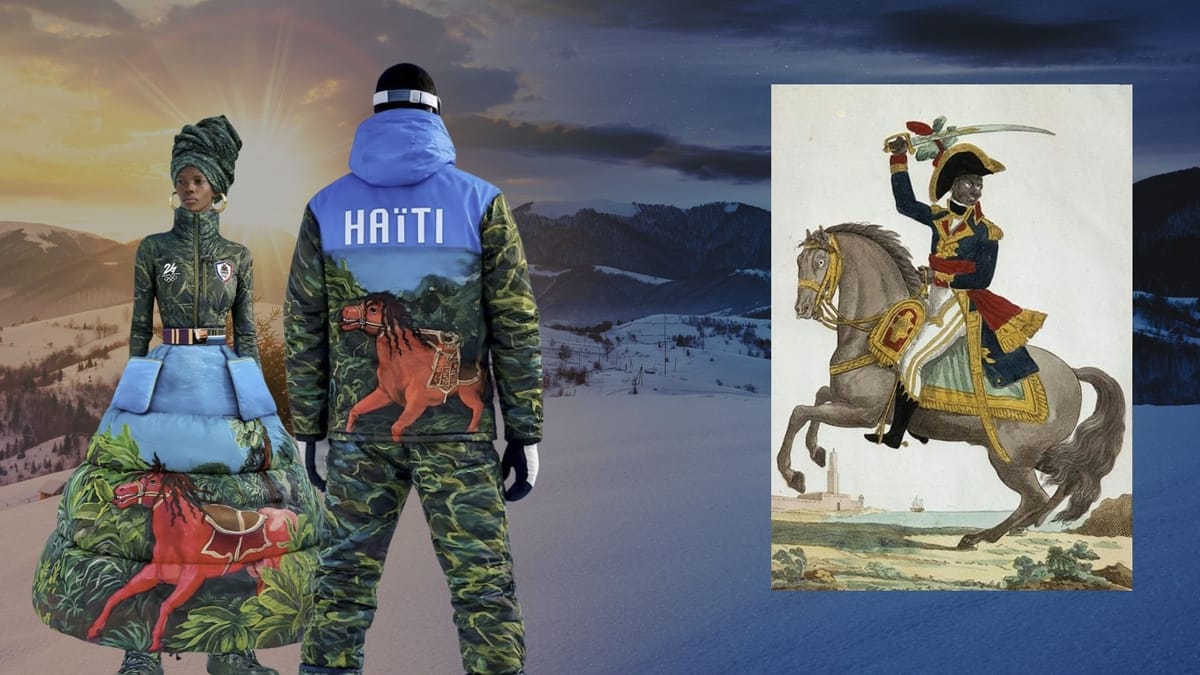
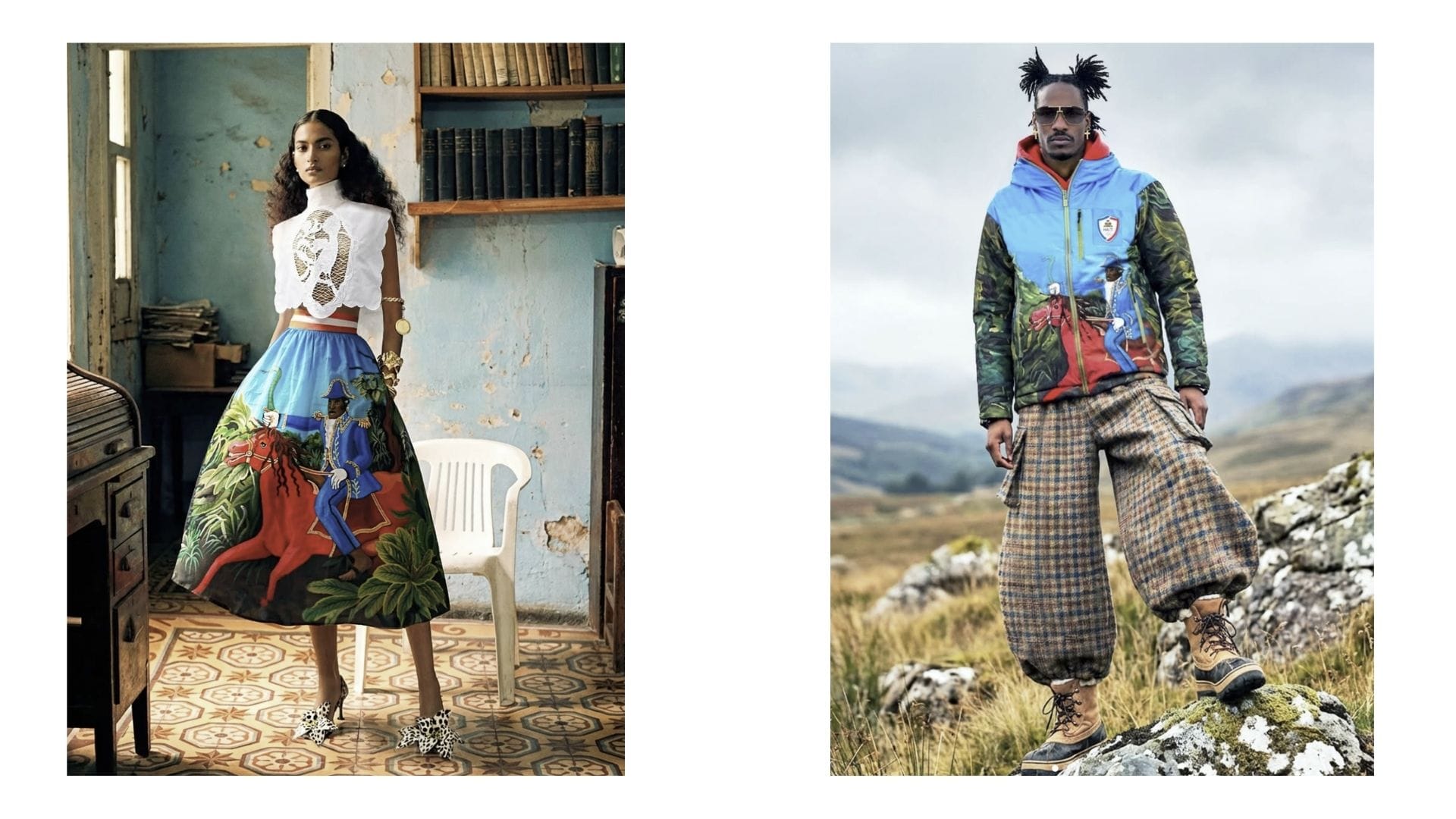
Amidst the hand-painted foliage motifs and tropical blue-sky background of the jacket and puffer skirt is a striking red horse. It is riderless. The IOC deemed the rider too "political" for the slopes.

✉️ letter #76
Last month’s Olympic Games delivered an unexpected, vibrant fashion surprise during the Opening Ceremonies: Haiti, a nation not known for its winter sports prowess, sent two athletes to the stage in uniforms that were absolute masterpieces of design. But there was something—or more specifically, someone—missing.
The Haitian puffer set was brought to life by Italian-Haitian designer Stella Jean. Amidst the hand-painted foliage motifs and tropical blue-sky background of the jacket and puffer skirt is a striking red horse. It is riderless. The IOC deemed the rider too "political" for the slopes.
Originally, that horse was to be mounted by Toussaint Louverture, the former slave who led the Haitian Revolution. When the IOC ruled the image violated rules barring political symbolism, Jean had to engage last-minute artisans to hand-paint the patriot out of existence.
I realize I am a week late for the Olympic news cycle, and I have missed the "official" window of Black History Month. But in climate time, these delays are negligible. There is a specific, quiet, and forever relevant exhaustion tied to being a spectator to this kind of history. With Haiti, we are constantly reckoning with an injustice that extends far beyond CO2.
🎼 the soundtrack | F.I.S.H. - Naïka
A musical accompaniment to the newsletter, this time featuring Haitian-American musician Naïka and one of her new singles, F.I.S.H. (F*ck it, Sh*t Happens) off her very, very new album, ECLESIA - because the vibes feel relevant.
Last semester, for my Climate Adaptation course here at Columbia, I was tasked with writing a case study on Haiti’s climate plans and the ongoing costs of its disaster-induced migrations. I stumbled upon a mathematical irony while assembling the research:
- To meet its Nationally Determined Contributions (NDC) and protect its people from the rising tide of climate-induced migration, Haiti’s total funding need is approximately $22 billion.
- After winning the world's only successful slave revolt, Haiti was coerced into paying France (and later U.S. banks) an "independence debt" to compensate former slaveholders. Adjusted for inflation and interest, that figure is estimated at $20–30 billion. Basically, more than it needs for its NDC.
Essentially, the capital Haiti once used to buy its way out of its "non-human" status is the exact amount it now needs to keep the island nation above water. Its right to exist now—through funding water conservation, coastal management, and renewable energy—is what was drained from its coffers to pay for its right to exist then.
The removal of Louverture from the uniforms is a bittersweet metaphor for Haiti’s climate reality. Just as the world asks Haiti to present a "sanitized" version of its history, the international community often frames its environmental crisis as a failure of local stewardship rather than a result of global extraction.
Haiti marches on. The last-minute change meant Haiti became the only Olympic team in history with hand-painted uniforms at the games, and Toussant or no Toussant, critics were in love with and could acknowledge the message of Stella Jean's art. As Jean noted, "His absence speaks louder than his presence ever could."
Post-Olympics, she released the original designs in a limited release on her Instagram – a portion of the proceeds will support educational programs in Haiti.
For the rest of us, it really doesn't feel like enough to applaud Haiti's resilience. When we look at Haiti's 1.4 million displaced people (a 34% increase just this year), I wonder if we can move beyond seeing them as victims, albeit ones with pride and dignity, and start seeing them as the creditors of a global debt.
I want to marvel at the regal beauty of Stella Jean’s work, but also remember that the removal of a revolutionary from a parka is just one more cut in a long history of violent cleaving. Haiti contributes only 0.02% of global emissions, yet it pays the highest price. We don't need "charity" for them; we need a return on an investment that was still being stolen from them less than a century ago.
For those interested, I've posted the transcript and slides to my Climate Adaptation case study:
 elaine
🪢related threads
- On resilience and winter sports: the Olympics may be over, but we shouldn't forget that the Paralympics are just beginning. [NPR]
- As we cheer for the "snow games," the ground beneath us is literally losing its grip—new data shows a 42km retreat at an Antarctic "weak spot" that underscores the fragility of our winter arenas. [Daily Galaxy]
- Good thing we can look to the fashion industry to make good on its promises for a more environmentally-friendly future... oh wait. 🙄 [Vogue]
- And lead fast... a new study confirms the pace of global warming has nearly doubled since 2015—the very year the world promised to slow it down. [Carbon Brief]
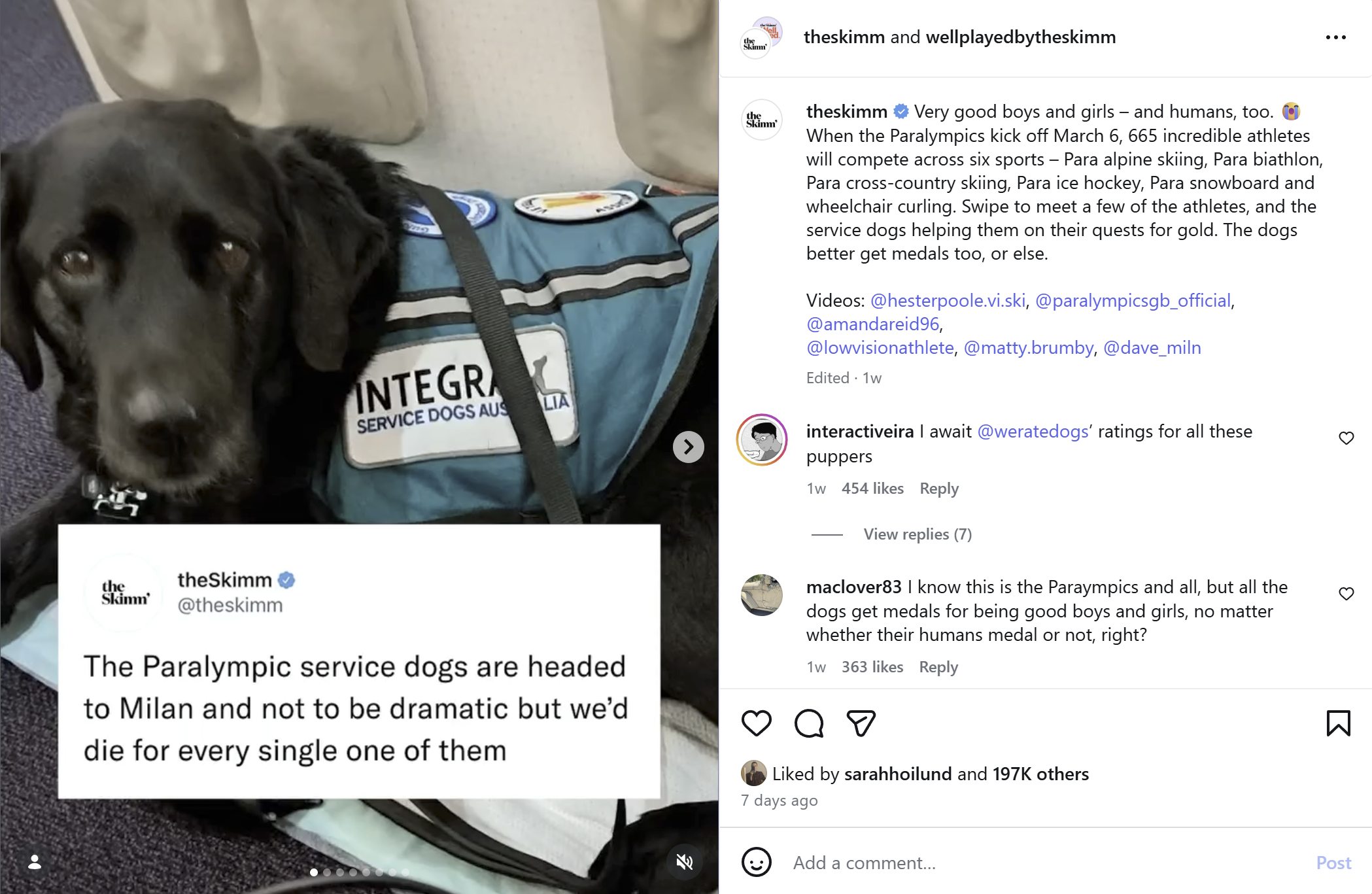
- Because I refuse to end on a note of systemic collapse, let's go back to the Paralympics: meet the service dogs currently proving that sometimes, the best adaptation strategies have four legs and a very wet nose. [NYPost]
✨enjoy these culture notes
Wake up babe, a Gorillaz music video dropped. And it is iconic.
Entirely hand-drawn and pretty heavily referencing The Jungle Book, it's supposed to be "a condensed explanation about what is being sung about on this record, which is essentially the story of life."
In a CBC interview, Damon Albarn and Jamie Hewlett described their album, The Mountain as a "playlist for a party on the border between this world and whatever happens next" born from the grief of losing their fathers.
While the album is a love letter to honoring those whom we've looked up to, the music video is a love letter to the old-school animation process, having taken 18 months to hand draw by London-based animation studio THE LINE. In an age where we're drowning in so much slop, it's genuinely exciting to see something so perfectly truly crafted.
🗨️a final quote
History is not the past. It is the present. We carry our history with us. We are our history. If we pretend otherwise, we are literally criminals.
-- James Baldwin
Stalk me on Social Media
Instagram | TikTok | LinkedIN | Twitter | Goodreads | Spotify